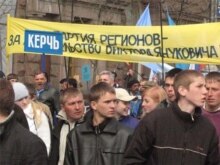
That speech, and one in Germany's Bundestag a month earlier, were part of a post-revolutionary victory lap after the massive public protests of the Orange Revolution propelled Yushchenko into the Ukrainian presidency -- and reduced his Moscow-backed rival, Viktor Yanukovych, to political ignominy.
Now Yushchenko and Yanukovych are once again locking horns.
This time, however, Yanukovych is prime minister and head of the lynchpin party in parliament's ruling coalition. And the cheers of Western support for Yushchenko? Nowhere to be heard.
"Any political questions in Ukraine need to be resolved by the Ukraine government," said State Department spokesman Sean McCormack, responding to Yushchenko's dissolution of the Verkhovna Rada following the defection of opposition lawmakers to the coalition.
And in Brussels, Adrian Severin, a member of the EU-Ukraine Parliamentary Cooperation Committee, said this time around, Europe was putting its support behind "values," rather than "people."
Yushchenko himself appears to acknowledge he cannot turn to the West for support on this battle. In an interview with RFE/RL on April 11, the president said Ukrainians must solve the current crisis "by themselves."
Orange Letdown
Some observers say many in the West have been disappointed by the inability of the Orange Revolution leaders to capitalize on their powerful public mandate and effectively lead the country down a new progressive path.
"The lethargy that you see, the hesitancy, or even the frustration on the part of Brussels and Washington has to do with the degree to which the Orange Revolution itself collapsed or disintegrated or eroded," says Robert Legvold, a professor at New York's Columbia University who specializes in post-Soviet politics.
Just months after the Orange Revolution, Yushchenko and his charismatic political ally, Yuliya Tymoshenko, had been reduced to constant bickering. By September 2005, Yushchenko removed Tymoshenko from her prime ministerial post. That move split the pro-Western Orange forces and opened the door for Yanukovych's political comeback and the victory of his Party of Regions in March 2006 parliamentary elections.
After months of haggling, Yushchenko, Tymoshenko, and Socialist Party leader Oleksandr Moroz appeared to revive the Orange forces and form a ruling coalition that would have returned Tymoshenko to the prime ministerial post.
But in the end, Moroz defected and instead formed a coalition with Party of Regions and the Communists. By August 2006, it was Yanukovych, and not Tymoshenko, who was confirmed as prime minister.
 Yushchenko (right) with U.S. Secretary of State Condoleezza Rice in Kyiv in December 2005 (epa)"The Orange Revolution alliance quarreled so much, it didn't have the sort of inner dynamism to create a government of its own," said Eugeniusz Smolar of the Warsaw-based Center for International Relations, who said he watched the months of haggling with a mixture of "sympathy and horror."
The fighting, he said, "destroyed, on the one hand, the cohesion -- and, on the other hand, some of the support -- of the population toward the government."
Divided Loyalty
Some analysts and politicians suggest the West could have done more to support pro-European forces in Ukraine by expediting the country's bid to join Western institutions like the World Trade Organization, the European Union, and NATO.
Brussels, which acknowledges expansion fatigue, has been firm in its refusal to bolster Ukraine's hopes of membership. But U.S. President Bush on April 10 signed legislation backing NATO membership for five countries, including Ukraine.
The fact remains, however, that Ukraine's eastern regions remain largely loyal to Russia, which adamantly opposes NATO expansion. As a result, Ukraine itself is deeply divided over whether it wants to join the EU or NATO. Some polls have indicated that most Ukrainians would reject membership in either if the issue was put to a referendum.
"There is a quite a large group of public opinion in Ukraine that is not terribly interested in joining the European Union, understanding that it has an important economic, social, and cultural interest in staying close to Russia," says Smolar.
So did the West fail, or Ukraine? "It's a complex situation," Smolar says. "I believe that the Ukrainian public and the Ukrainian elite didn't do enough. Whether the West could do more... I believe it could do more, but I am not sure it could do much more."
Wider Implications
Ukraine's inconstancy regarding the West may prove an inconvenience elsewhere in the former Soviet Union -- particularly in Georgia, whose NATO bid also got U.S. President Bush's blessing this week.
 Anti-NATO protests in Ukraine last month (TASS)Georgia kicked off the wave of colored revolutions with its 2003 Rose Revolution, and President Mikheil Saakashvili has traditionally kept close ties with Yushchenko. But Legvold at Columbia University says Georgia's own Western ambitions may be hampered by the ongoing Ukrainian stalemate.
"I don't see any prospect that Georgia can be considered for NATO membership -- even if it seems in some fashion more qualified -- until the Ukrainian issue is settled," he says. "You can't jump over Ukraine and address the Georgian question separately."
Ultimately, U.S. and EU support for Yushchenko and Ukraine's pro-Western forces may also be muted because the current composition of the Ukrainian government is the product of elections that were universally judged to be among the fairest and cleanest in post-Soviet Ukraine.
The Orange Revolution had a clear villain in Yanukovych, whose backers blatantly falsified election results. This time around, he is the legitimate head of government and leads the most popular party in the country.
Marek Siwiec, deputy chairman of the European Parliament, said on April 11 that Yushchenko can no longer expect the unequivocal Western support he enjoyed in 2004.
"All parties have a legal democratic mandate now," Siwiec said. And that makes a "huge difference."
On another Front
Signs Of Breakthrough In Ukrainian Political Crisis
 |
| President Yushchenko |
| (Courtesy Photo) |
He said he could participate in the ballot even if the Constitutional Court rules against Yushchenko, provided all participants in the political process agree.
Yanukovych had previously said he would agree to the poll only if an early presidential election was held simultaneously.
MORE: Coverage in Ukrainian from RFE/RL's Ukrainian Service.
SUBSCRIBE: "RFE/RL's Belarus, Ukraine, And Moldova Report"
Yanukovych and his allies have asked the Constitutional Court to examine the legality of Yushchenko's April 2 decree to dissolve parliament and call early elections.
Elections Question
In an interview with RFE/RL's Ukrainian Service on April 11, President Viktor Yushchenko said the only democratic way to resolve the political crisis in his country is by holding new elections.
But speaking today at a news conference in Kyiv, Yushchenko indicated he was prepared to allow for more time before the elections, slated for May 27.
Speaking to RFE/RL, Yushchenko assured that dialogue between all forces in the dispute is continuing.
"I think the difference is that we are constantly consulting. There is an active dialogue. We have a regular dialogue with all the institutions of power. There is no feeling of isolation on the part of the parliament, the government, or the presidency as far as communication or dialogue is concerned," Yushchenko said.
Ukraine's Constitutional Court is due to start hearings into the decree's legality on April 17, although five out of 18 judges are refusing to consider the case, citing political pressure.
Speaking at a press conference today, Yushchenko called on Constitutional Court judges to be courageous and said that a court decision was a matter of principle for 48 million Ukrainians.
International Efforts
Meanwhile, international diplomatic efforts to solve the crisis are under way.
Russian and Polish diplomats were in the capital to discuss with Ukrainian government officials ways of resolving the crisis.
And the European Parliament's vice president, Marek Siwiec, held a news conference in Brussels today following a fact-finding mission in the Ukrainian capital.
But Yushchenko said he is confident that Ukrainians could resolve the crisis "by themselves":
"We should settle these internal problems through political means. Ukrainians should go through this by themselves because this [experience] is not something that you can borrow from someone else or receive it as a gift from someone," Yushchenko said.
Copyright (c) 2007. RFE/RL, Inc. Reprinted with the permission of Radio Free Europe/Radio Liberty, 1201 Connecticut Ave., N.W. Washington DC 20036. www.rferl.org and http://dndtalk.com/Joomla,dndtalk.ca