Showing posts with label Pakistan. Show all posts

11:57 AM

(0) Comments

Pakistan Blames IMU Militants For Afghan Border Unrest

lafrance

,

Uzbek authorities have waged a protracted campaign to root out the IMU For months, media reports in the region have claimed that militants from Central Asia are conducting violent operations in Pakistan's volatile tribal areas along the Afghan border.

Now, Pakistan Prime Minister Yousaf Raza Gilani has not only confirmed those reports, according to which hundreds of IMU militants are holed up in Pakistan's tribal belt, but also pinned some of the blame for a recent rise in violence there on the Central Asian militants.

Speaking on June 28, Gilani stated that "foreign elements hailing from Central Asian republics are disturbing peace in the tribal areas." Gilani was apparently referring to the mainly Uzbek Islamic Movement of Uzbekistan (IMU), an Al-Qaeda-inspired group originally founded to topple Central Asian governments and replace them with an Islamic caliphate.

He gave no other details. And what Pakistan intends to do about the presence of the militants remains unclear -- although senior officials including Major-General Ahtar Abbas acknowledge that military action against them is not imminent.

"There are no operations imminent because, as you know, there are already peace talks between the government and tribes there," Abbas said.

The IMU, which made headlines in January after reports of bloody clashes in South Waziristan with local tribesmen, first emerged as a militant group bent on overthrowing autocratic Uzbek President Islam Karimov. Many of its members were hosted by Al-Qaeda and the Taliban in Afghanistan but ended up in Pakistan following the U.S.-led topping of the Taliban in late 2001.

The Pakistani government, in a bid to diffuse rising violence in the area, has been carrying out negotiations with pro-Taliban militants and local tribal leaders. But the IMU militants appear not to be part of this process.

Indeed, Pakistani officials like Abbas say they want to the IMU members to leave the country but would prefer that the problem be solved by local leaders.

"Allow a homegrown solution to emerge is what government is trying to do. This solution would comprise of first to ask [the tribes] to control the area and remove all the foreigners," Abbas said. "The government wants the tribes to throw out the foreigners in the area and is ready to give them some time in this regard."

Gilani reiterated the government's desire to negotiate peace deals with those who put down their weapons. But he added that Pakistan, which this week launched an attack on pro-Taliban militia near the city of Peshawar, would continue to use force against those who resort to violence and sow insecurity.

Experts believe that the group, with some 500 members, now poses more of a threat to Pakistan than to the Uzbek regime.

Pakistani journalist and the author Ahmed Rashid told RFE/RL that the group has localized its activities in Paksitan's tribal belt.

"We've seen more and more of these people coming in. We have seen more suicide bombers in Afghanistan who supposed to be Uzbek from Uzbekistan," Rashid said. "Clearly, there's something going on here."

History Of Violence

Pakistan's "Daily Times" has described IMU leader Tohir Yuldash as staunch follower of Al-Qaeda's second-in-command, Aiman al-Zawahiri. Yuldash reportedly believes that jihad should first target not the United States but "hypocritical Muslims" who somehow support Washington.

Uzbek militants have been blamed in some reports for violence against and disregard for local Pashtun culture in Waziristan, including killings and assassination attempts against some tribal leaders considered loyal to Pakistan's central government.

Last year, Pakistani forces claimed to have killed at least 150 Uzbek militants.

Early this year, the IMU said it had joined up with the forces of local militant leader Baitullah Mehsud to battle Pakistani forces and local tribal leaders. In an audio clip sent to RFERL's Uzbek Service in January, a self-described IMU spokesman, Abdulfattoh Ahmadi, purported to describe those clashes.

"For a week, Pakistani forces and tribal Muslims have engaged in heavy fighting in Spinkay, Makin, and Razmak regions," Ahmadi said. "Heavy weapons constantly are targeting civilians and women with babies can be seen running away in severe cold. However, government forces also suffer losses. Some government positions are seized and some burned down."

What is unclear is the real strength of the IMU, which is on the U.S. State Department's list of designated foreign terrorist organizations.

There have been several past reports that Yuldash 40, had been killed. But each time they were apparently disproved with the release of fresh audio addresses from the Uzbek militant leader.

Karimov, speaking after the Taliban's ouster from power in 2001, said "the IMU posses no threat to Uzbekistan." But to help prevent militants from invading the former Soviet republics of Central Asia, governments there have formed a rapid reaction forces under the pro-Russian Collective Security Treaty Organization.

Meanwhile, from South Waziristan, the IMU continues to search for ways to replenish its depleted and scattered ranks by promoting a new strategy - one that seeks to take aim at the government of Pakistan and its supporters.

10:25 AM

(0) Comments

NATO, Pakistani Troops Kill Taliban On Afghan Border

KABUL -- NATO troops in Afghanistan and Pakistani soldiers together killed a number of militants along the rugged border, the NATO force said, in a rare show of close crossborder military cooperation.

Afghan officials have for the last month showered Islamabad with accusations it was aiding Taliban insurgents against Kabul, and NATO said on June 29 there could be no peace in Afghanistan as long as militants have sanctuaries in Pakistan. But Afghan, Pakistani, and NATO troops do have regular and open lines of communication to try to coordinate actions along the long and porous border.

Taliban insurgents fired rockets and rocket-propelled grenades at an outpost of troops from NATO's International Security Assistance Force (ISAF) in the Spera district of Khost province in eastern Afghanistan on June 30.

The troops responded with mortar, artillery fire, and air strikes, and the militants fled across the border.

"ISAF forces thus coordinated with the Pakistan military border area counterparts; and the Pakistan border force subsequently fired artillery on the retreating insurgents inside Pakistan," ISAF said in a statement.

ISAF does not disclose Taliban casualty figures.

Pakistani military spokesmen were not immediately available for comment.

The coordinated attacks contrast with a border clash on June 10 in which Pakistan said 11 of its soldiers were killed in an air strike by U.S. forces in the border area.

U.S. officials have ordered an investigation into the incident, but say those killed were firing on U.S. forces and that there were no Pakistani military units in the area at the time.

Almost all ISAF troops in eastern Afghanistan are American.

Poor relations and mutual distrust between Pakistan and Afghanistan have dogged efforts to undermine the hard-line Islamist insurgency, which now threatens both countries along the Pashtun belt on both sides of the

11:56 AM

(0) Comments

Pakistani Troops Seek To Counter Taliban Threat To Peshawar

lafrance

A home in Bar Qambarkhel said to have belonged to Haji Namdar, the head of a hard-line group seeking Taliban-style rule, on June 30

A home in Bar Qambarkhel said to have belonged to Haji Namdar, the head of a hard-line group seeking Taliban-style rule, on June 30

Pakistan's current offensive against pro-Taliban militants in a western tribal region near the North West Frontier Province's capital, Peshawar, is regarded as the country's first military response to ease concerns over a possible Taliban takeover of that strategic metropolis.

The operation comes after months of negotiations and attempts at peacemaking with the Taliban have yielded few tangible results.

Some 5,000 Pakistani paramilitary troops -- equipped with tanks, armored personnel carriers, and artillery -- have advanced into the town of Bara in the Khyber tribal district, a mere 15 kilometers west of Peshawar.

The aim of their operation is to put an end to the growing influence of pro-Taliban militants in and around Peshawar, a strategic city of some 3 million people located just east of the famous Khyber Pass leading into Afghanistan. The offensive also underscores the role of Peshawar, the purported birthplace of Al-Qaeda, as a key front in the battle against the Taliban and Al-Qaeda in Pakistan and Afghanistan.

"If Peshawar falls then the whole of [North West Frontier Province] will fall and the [eastern province of] Punjab is not far," Ijaz Khan, a professor of international relations at Peshawar University, told RFE/RL. "It is wrong to assume that consequences of such an eventuality will not spread. This will dramatically worsen the whole situation."

Some analysts worry that the offensive, like previous Pakistani military actions in the area, will be temporary and lead to more deal making with militants. So far, the military operation has met with little resistance because rival pro-Taliban groups have been involved for years in violent sectarian conflict with one another.

One group is Lashkar-e Islam. The pro-Taliban militia controls large swaths of the Khyber district and is enforcing harsh measures to regulate public life. Lashkar-e Islam is locked in conflict with Ansar-ul-Islam, a rival militia. But the government responded to its activities only after the group reportedly kidnapped 16 Christians from Peshawar on June 21 and made raids into the city.

Regional Ties?

Reports from the tribal region on June 30 said Pakistani forces destroyed a house in the village of Bar Qambarkhel that was owned by another Islamic militant leader -- killing at least six people. The house belonged to Haji Namdar, head of the hard-line Vice and Virtue Movement, a group seeking Taliban-style Islamic law. Reports indicate Namdar's group has sheltered Arab and Central Asian militants suspected of carrying out attacks on NATO supplies being transported through the Khyber Pass.

A senior Pakistani security official has confirmed that Namdar's house was destroyed, saying that Pakistani ground troops were involved in the operation.

Namdar reportedly survived the explosion that destroyed his home. Namdar's spokesman claims the explosion was caused by a NATO missile strike.

On June 28, Pakistani troops destroyed the home of Lashkar-e Islam leader Mangal Bagh in the town of Bara. They also demolished the headquarters of the rival Ansar-ul-Islam group early on June 29 after the government in Islamabad outlawed all three groups.

Apart from the Khyber Pass to the west of Peshawar, Taliban factions also have been extending their influence from the tribal town of Darra Adam Khel on a strategic highway about 40 kilometers south of Peshawar.

Meanwhile, from the tribal districts of Mohmand and Bajaur about 30 kilometers north of Peshawar, fighters from other Taliban-linked groups have been making inroads into the city and the nearby towns of Charssada and Mardan.

Mounting Fears

Concerns about a growing Taliban threat to Peshawar were raised last week when Pakistani and international media published reports about the possibility the city might fall into Taliban hands.

Afrasiab Khattak, a peace envoy from the Awami National Party-led provincial government, has downplayed the threat.

"The peace and security situation in Pakistan over the past few years has deteriorated because of the flawed polices of [President] General Pervez Musharraf -- years of bad policies and judgments have resulted in the current grave state of affairs," Khattak said. "The security situation in FATA [Federally Administered Tribal Areas] and the adjacent settled districts of NWFP is bad. Across the border in eastern and southern Afghanistan the security situation is dire, too. Peshawar is not facing an imminent particular security threat. But it shares the security situation and concerns of the surrounding regions."

Others in Peshawar offered a more alarming analysis.

Ijaz Khan said the Taliban have gradually increased their influence over the past five years from Waziristan, some 500 kilometers south of Peshawar. He said their influence is now visible, with the militants making sporadic raids into Peshawar in a bid to regulate residents' lives by blowing up DVD shops and targeting those considered un-Islamic.

"The notion that Taliban have laid siege to Peshawar might not be right in the conventional sense as their forces are not waiting at the gates to take over the city," Ijaz Khan said, "but their influence is gradually increasing and the government seems to have no clear policy to confront it."

Key Questions

Located on a key route that links Pakistan and Afghanistan, Peshawar had been a bastion for the anti-Soviet Afghan Mujahedin resistance during the 1980s. Radical Arab veterans of that war also founded the Al-Qaeda network in Peshawar during the late 1980s.

Provincial police in NWFP recently announced a comprehensive plan to protect Peshawar. But the plan has so far contributed little to improving security.

The provincial government advocates a comprehensive strategy of political empowerment, economic development, and peace building. Khattak is adamant that Pakistan's new democratically elected government will deliver on its pledge to restore peace and security in the country.

"The new government has been in office for less than a hundred days, but over the past few weeks, we had a lot of high-level meetings in Islamabad and Peshawar and we have completed a comprehensive strategy," Khattak said. "This strategy will be implemented and you will see its results soon. The government is fully aware that protecting the life and property of its citizens is its primary responsibility. Unlike in the past, when using military might was the first and only strategy, the new government will engage in negotiations [with militants] but will use force against those who break the law."

Still, many analysts pointed out that Pakistan's elected leaders may not have the authority or resources to implement any well-intentioned comprehensive anti-terror policy. That is because the country's powerful military establishment continues to dominate vital policy decisions related to security.

Ijaz Khan said the actions of the current government resemble what he described as futile efforts by the previous regime.

"So far, the military actions consist of a few days of fighting resulting in the casualties of combatants from both sides and some innocent citizens," Ijaz Khan said, "Then they start negotiations, which often result in deal making. Such deals, in turn, result in increased Taliban influence."

Many Peshawar residents will have similar concerns, at least until they see real improvements to security in their beleaguered city and the surrounding regions.

10:41 AM

(0) Comments

Pakistan forces 'clear' Khyber town

lafrance

,

Paramilitary troops with tanks reportedly quickly cleared the Bara region of fightersPakistan has claimed success after a major military offensive cleared anti-government fighters from a town in the northwest of the country and troops returned to abandoned outposts.

Paramilitary troops were on Sunday seen patrolling Bara in the Khyber region in tanks had set up sand-bag checkpoints.

"The government has been successful in the operation in Khyber which was carried out to safeguard Peshawar," Rehman Malik, the interior ministry chief, told a high-level meeting in Peshawar.

He did not say when the offensive would end.

The government launched the operation after attacks on supply convoys for the US-led force in Afghanistan and reports of fighters threatening the city of Peshawar.

There has been growing concern about threats to Peshawar since a Taliban force from Khyber entered the city two weeks ago and seized 16 Christians, before later releasing them.

Around 1,500 troops and police commandos were deployed along the Peshawar border with the Khyber tribal region and its suburbs to protect the city's more than 1m populace.

Buildings destroyed

Muhammad Siddiq Khan, a local official, said that a tribal force that had been forced to abandon its posts in the region several months ago returned to the checkpoints on Sunday, he said.

In a nearby village on Sunday, soldiers blew up a building belonging to the Ansar-ul-Islam group, which is purportedly linked to the Taliban and has been accused of sending fighters across the border into Afghanistan.

"There was no resistance as the building used by Ansar-ul-Islam as their centre was empty," a security official said.

The previous day troops had demolished the house and headquarters of Mangal Bagh, head of the separate Lashkar-e-Islam (LI) group, which officials have said is not linked to the Taliban.

Bagh's group has been accused of robbing vehicles on the Khyber Pass, although officials said his men were not responsible for cross-border attacks on the US-led forces in Afghanistan.

Bagh told a newspaper that he did not know why he was being targeted and said his men had never attacked security forces.

"I have told LI volunteers to go home and not to resist any action," he was quoted as saying by The News, an English language newspaper.

Peace talks halted

Baitullah Mehsud, a senior pro-Taliban leader in Pakistan, has reportedly called off peace talks with the government following the start of the offensive.

"The talks will remain suspended until the government stops talking about operations and attacks against us," the Reuters news agency quoted Mehsud as saying.

About 1,500 troops and police were deployed on the Peshawar-Khyber border
A large military contingent was also reported to have reached the Jandula area in South Waziristan.

Another armed group said that an offensive in the area would only create further problems.

"If the government thinks there is any issue to address, that should be resolved through talks not by the use of force," Munsif Khan, spokesman for the Virtue and Voice organisation, said.

"We are ready for talks with the government."

Yousuf Raza Gilani, Pakistan's prime minister, denied that the government had launched the offensive after pressure from Washington and said negotiations with armed groups in the northwest would continue.

"This is our war and it is for our own survival," hei told reporters after a meeting of former premier Benazir Bhutto's Pakistan People's Party in Lahore.

"Nobody will be allowed to execute others publicly, kidnap minorities, set fire to girls' schools and barber shops in Pakistan.

"We do not take any pressure and I have also explained my policy to US President Bush that we believe in dialogue and want development, health, education and to eliminate terrorism from the country."

Gilani was in Peshawar on Saturday but insisted that his trip was not related to the military operation.

10:33 AM

(0) Comments

Islamabad Launches Military Operation Against Taliban

Pakistani troops patrol on vehicles in Hayatabad near the Khyber tribal region

Pakistani forces have launched a military operation against Taliban militants near the northwestern city of Peshawar. The offensive in the Khyber tribal region marks the first major military action which Pakistan's newly elected government has taken against the Taliban on its territory.

Pakistani forces reportedly bombarded suspected militant hideouts with mortar shells in the mountains in Khyber.


Pakistani journalist Syllab Massud, speaking to RFE/RL's Radio Free Afghanistan from Peshawar, said the situation is "tense."

"[People] are really worried about their futures because nobody knows what will happen next," Massud said.

Security officials were quoted as saying an around-the-clock curfew has been imposed in the Bara area near Peshawar, close to the Afghan border. Meanwhile, troops were deployed, blocking the main road into Khyber.

No casualties have been reported, but local newspapers report hospitals in Peshawar have been put on alert.

Prime Minister Yousuf Raza Gilani, who came to power following February general elections, is in Peshawar. He said his government, which has engaged in a cease-fire and negotiated peace deals with Pakistani Taliban leaders, would not allow the tribal areas to descend into chaos.

'We Will Use Force'

"We are ready to negotiate with those who are ready to put down their weapons," he said. "We are supporting a peace deal with those who want security in the region. We don't oppose any peace negotiation with those people. We will use force against those who are causing insecurity."

The crackdown follows increased activity of Taliban fighters in Khyber and in the sprawling city of Peshawar over the past year. Armed militants have threatened owners of music and video shops to close down, and ordered barbers to stop shaving men's beards.

The Khyber Pass provides the main road link to neighboring Afghanistan.

Kabul and NATO complain about an increase in crossborder attacks following the Pakistani peace deals. Afghan officials also accuse Pakistan of secretly supporting the insurgents and harboring their leaders -- a charge Pakistan's civilian and military leaders deny.

'Clearly A Concern'

On June 27, U.S. Defence Secretary Robert Gates criticized Pakistan for failing to put pressure on Taliban forces along the border, saying it had fuelled a rise in violence.

"The ability of the Taliban and other insurgents to cross [the Afghanistan-Pakistan] border and not being under any pressure from the Pakistani side of the border is clearly a concern," Gates said. "I think that's the area that needs to be addressed with the Pakistani government."

Speaking at a news conference in Washington, Gates said efforts by the Pakistani government to negotiate a peace agreement with tribal leaders had taken the pressure off insurgent groups.

Reacting to the latest government military offensive, Pakistani Taliban leader Baitullah Mahsud said he was suspending peace talks with Islamabad and threatened retaliation across Pakistan unless military offensives against his group stopped.

RFE/RL's Radio Free Afghanistan contributed to this report

10:01 AM

(0) Comments

Pakistan forces in Khyber offensive

lafrance

Hundreds of troops have been deployed in the areas surrounding Peshawar Pakistani security forces have launched a military operation against Taliban fighters in the Khyber tribal region near the northwest city of Peshawar.

Malik Naveed Khan, police chief of Pakistan's North West Frontier province, of which Peshawar is the capital, said the crackdown on Saturday was "going on smoothly".

"There has been no resistance, so far," he said, speaking to Reuters news agency. "No casualties, so far."

The historic Khyber Pass, long known as a den for smuggling, is the main road link with Afghanistan and provides crucial supplies to US forces across the border.

Military sources told Al Jazeera that security forces were shelling suspected Taliban hideouts in the mountains and had already destroyed three observation outposts.

The operation prompted a swift response from Baitullah Mehsud, a senior pro-Taliban leader in Pakistan, who has reportedly called off peace talks with the government.

"The talks will remain suspended until the government stops talking about operations and attacks against us," Reuters quoted Mehsud as saying.

"The situation is such that [the Taliban] are all around Peshawar, they are on our doorstep"

Mahmood Shah, former security chief in the tribal regions
He said he suspected similar operations being ordered against Taliban groups elsewhere in the region.

A large military contingent is also reported to have reached the Jandula area in South Waziristan.

A Taliban-linked group said an offensive in the area would only create further problems.

"If the government thinks there is any issue to address, that should be resolved through talks not by the use of force," said Munsif Khan, spokesman for the Virtue and Voice organization. "We are ready for talks with the government."

Peshawar fears


There has been growing concern about threats to Peshawar from Taliban fighters. Two weeks ago, a Taliban force from Khyber entered the city and seized 16 Christians, before later releasing them.

Mahmood Shah, a former security chief in the tribal regions, said: "The situation is such that [the Taliban] are all around Peshawar. They are on our doorstep."

"The situation is like water flowing into a field and until you have some obstruction to stop it, you will drown. We are drowning."

Al Jazeera's Kamal Hyder said there was likely to be some reprisal from Taliban fighters because of the the military operation, such as rockets being fired at Peshawar.

Around 1,500 troops and police commandos were deployed along the Peshawar border with the Khyber tribal region and its suburbs to protect the city's more than 1m populace.

Mujeeb Khan, a senior local official, said a round-the-clock curfew was imposed in the Bara area bordering Peshawar, and heavy contingents of troops were blocking the main road into Khyber.

"All bazaars are shut, and residents have been asked not to come out of their homes," he said.

Yousuf Raza Gilani, Pakistan's prime minister, was in Peshawar on Saturday. However, he insisted his trip was not related to the military operation

11:12 AM

(0) Comments

Pakistan blamed for Karzai attack

lafrance

,

The attack on Karzai took place during a miliary paradeAfghanistan's intelligence agency has accused its Pakistani counterpart of masterminding an assassination attempt on Hamid Karzai in April.

The Afghan president survived the April 27 attack at the annual military parade, but three Afghans were killed, one of them a parliamentarian.

Sayed Ansari, a spokesman for the Afghanistan's national intelligence agency, said on Wednesday his organisation believed Pakistan's Inter-Services Intelligence (ISI) was involved.

"The investigations, the documents we found and the confession of suspects arrested, show the real schemer and organiser ... of the terrorist attack is the intelligence agency of Pakistan, the ISI," Ansari said.

The statement came a day after Karzai's spokesman made a similar accusation.

Homayun Hamidzada, Karzai's spokesman, said on Tuesday: "Evidence shows the hallmark of a particular foreign intelligence agency which we believe was behind this attack.".

He, however, refused to name the foreign country or the spy organisation.

'Constant contacts'

Ansari said mobile phones seized from the men involved in the attack showed they had "constant contacts" with bases across the border with Pakistan.

The spokesman said eight of the 16 people arrested over suspected links to the attackers were government employees.

He did not give details, but authorities had earlier said a defence ministry weapons expert and a police nurse were arrested for allegedly facilitating the attack.

Islamabad denies any role in the attack.

11:19 AM

(0) Comments

Judicial blow for Pakistan's Sharif

lafrance

The Lahore court's ruling has angered Sharif's party supporters in Punjab provinceNawaz Sharif, Pakistan's former prime minister, will not be able to run for parliament in forthcoming by-elections.

The ruling, announced on Monday by the Lahore High Court, will not allow Sharif to run for Thursday's elections because of previous convictions.

Sharif's rival candidates from the by-election had argued that loan defaulters and people convicted of criminal charges could not contest election.


The Lahore High Court accepted their case.

An order issued by the court said: "Nawaz Sharif is not a qualified candidate to contest a by-election."

Shahbaz, Sharif's brother, also had a case referred to the chief election commissioner.

The court said Shahbaz could continue as chief minister until a final decision on his case was made.

"It's a political decision and we reject it. It is a conspiracy against democracy," Siddiqul Farouq, a spokesman for Sharif's PML-N, said.

The judges who gave the ruling were appointed by Pervez Musharraf, the Pakistani president, after he sacked dozens of judges under emergency rule.

'Musharraf's agenda'


Sharif's allies were furious, with dozens chanting "Go Musharraf, go" outside the court and angry lawmakers walking out of the provincial assembly in protest.

At least 100 Sharif supporters had burned tires in the street.

Ahsan Iqbal, a senior PML-N leader, said: "They are implementing Musharraf's agenda."

The decision is a major political setback for Sharif, making it impossible for the Sharif, the leader of a junior party in the governing coalition, to become prime minister unless the ban on his candidacy is overturned.

Sharif was also barred from running in February elections because of convictions related to his ouster in a 1999 coup, which was left by Musharraf.

Earlier this month, the nation's election commission effectively cleared him to run in by-elections after a tribunal set up to decide the matter failed to reach consensus.

Pervez Rasheed, Sharif's spokesman, said Sharif will appeal the decision before the elections.

10:30 AM

(0) Comments

Pakistan remembers Bhutto

lafrance

,

Bhutto was assassinated on December 27Pakistan's parliament has observed a moment of silence to honour slain ex-premier Benazir Bhutto on her birthday.

Bhutto was killed in a gun and suicide bomb attack on December 27 in Rawalpindi, a garrison city near the capital Islamabad.

Yousuf Raza Gilani, the Pakistani prime minister, told parliament on Saturday that a monument would be built at the site of Bhutto's assassination and that a main road in Rawalpindi and the hospital where she died would also be named after her.

"We will accomplish the mission of our great leader and make Pakistan a peaceful democratic and welfare state," Gilani said.

Gilani also announced that, to mark the occasion, death sentences of all prisoners would be commuted to life imprisonment and a 90-day reduction in jail terms would be given to many inmates.

Bhutto's Pakistan Peoples Party has started a week-long blood donation campaign and the government has re-named Islamabad international airport after Bhutto, who was born on June 21 1953.

Asif Ali Zardari, Bhutto's widower and now the chairperson of her party, attended memorial services in her native town of Gharhi Khuda Bakhsh where she was buried in the family mausoleum.

Bhutto's father, former premier Zulfiqar Ali Bhutto, was hanged in 1979 on the orders of military dictator Zia ul-Haq, propelling his daughter to carry on his legacy.

After Zia died in a mysterious plane crash in 1988, Bhutto - at the age of just 35 - became the first female prime minister of an Islamic country.

She was elected twice, and both times she was thrown out of office on allegations of corruption.

10:58 AM

(0) Comments

Pakistan troops killed in Kashmir

lafrance

Pakistan MapFour Pakistani soldiers have reportedly been killed in clashes on the border with Indian-controlled territory in the disputed Kashmir region.

A Pakistani military spokesman said that his soldiers exchanged fire with "unknown miscreants" along the the so-called Line of Control which separates Indian and Pakistani forces.

"Two of our soldiers embraced martyrdom at the spot and tw others injured later died at hospital," Major-General Athar Abbas, Pakistani military spokesman, said on Thursday.

He said that the Pakistani patrol came under attack from a wooded area along the frontier near the village of Battal.

Abbas said the soldiers returned fire and afterwards search parties were sent to hunt the attackers.

"The fire was not from the Indian bunkers," he said.

Infiltration


Lieutenant Colonel Shantanu Dass Goswami, an Indian army spokesman, said Indian and Pakistani troops both fired at the attackers, who he said were attempting to infiltrate the Indian side from Pakistan.

The fighting lasted about five hours, he said.

"There was an information sharing from both the sides to zero in on the militants," Goswami said.

Last week, India said that armed men ambushed an army vehicle and killed five soldiers on its side of the frontier.

Control of the Himalayan region is split between India and Pakistan, which both claim the whole region, and have fought two of their three wars over it.

However, violence between the nuclear-armed neighbours has declined since they launched a peace process in 2004.

Separatist fighters have been battling Indian rule in Indian-controlled Kashmir since 1989 and they reportedly slip across the frontier from Pakistani Kashmir into Indian Kashmir to battle Indian troops.

New Delhi has accused Pakistan of training and arming the separatists, a charge that Islamabad has denied.

Indian and Pakistani officials are due to meet in Islamabad next week to try to boost cooperation against terrorism as part of their peace process.

10:55 AM

(0) Comments

Karzai's Retaliation Threat Inflames Relations With Pakistan

lafrance

,

Karzai has threatened to send Afghan troops across the Pakistani border

Karzai has threatened to send Afghan troops across the Pakistani border

Afghan President Hamid Karzai has pleaded for years with Islamabad to stop Taliban fighters based in Pakistan's tribal regions from launching attacks in Afghanistan.

In the past, Karzai has complained that Pakistani security forces have turned a blind eye to the Taliban's cross-border attacks, allowing them to strike and then flee back to safe havens in Pakistani territory.

But on June 15, Karzai raised his criticism to a new level. He accused Pakistani forces of supporting Taliban leaders in the tribal regions, and threatened to send Afghan troops across the border to kill extremist leaders.
"Afghanistan has the right of self-defense," Karzai said. "When they cross the territory from Pakistan to come and kill Afghans and to kill coalition troops, it exactly gives us the right to go back and do the same."

Karzai stressed that he was not threatening to invade Pakistan, saying instead that limited incursions were needed to kill specific Taliban leaders. Nevertheless, the threat angered Pakistan's new government, which summoned the Afghan ambassador to issue a formal complaint.

Pakistani Journalist Criticizes Nation Building In South-Central Asia

But U.S. President George W. Bush, asked on June 16 whether he supported Karzai's threat, made no reference to Islamabad's concerns about its sovereignty and territorial integrity. Instead, Bush urged Pakistan to work more closely with Afghan and U.S. forces in the fight against terrorism.

"Our strategy is to deny safe haven to extremists who would do harm to innocent people, and that's the strategy of Afghanistan," Bush said. "And it needs to be the strategy of Pakistan. It's in all of our interests to prevent those who murder innocent people to achieve political objectives to gain safe haven."

Bush’s comments come as relations between U.S. and Pakistani security forces appear to be at a new low. Last week, a U.S. air strike killed 11 Pakistani soldiers within Pakistani territory. The Pentagon says it targeted a group who had attacked U.S. soldiers in Afghanistan and then fled back to Pakistan.

U.S. military commanders in Afghanistan have complained for years about the trustworthiness of Pakistani security forces, telling RFE/RL and other international news organizations that informing Pakistan in advance about border operations against the Taliban meant risking the lives of U.S. troops.

Washington's growing distrust was highlighted last week by the release of a Pentagon-funded study by RAND Corporation. That study concludes that individuals in Pakistan's Frontier Corps and intelligence services support the Taliban by providing them with intelligence about the movements of coalition forces in Afghanistan.

Ahmed Rashid, a Pakistani journalist and prominent author who is critical of the international approach in Afghanistan, tells RFE/RL that Washington has become frustrated with Pakistan's military.

"There is a very massive breakdown between the U.S. and the Pakistani military. I think talks between these two have failed," Rashid says. "Whatever the details are of this clash [and air strike], we really don't know what happened. There are many versions. But I think the real issue was that the Americans are clearly sending a very tough message to the Pakistanis."

Backing From Washington?

Analysts agree that without U.S. military support, Afghan forces would have little chance of success in a battle within Pakistan's tribal agencies. But it's unclear if Washington is willing to provide that support. James Phillips, a research fellow at the Washington-based Heritage Foundation, believes Karzai’s threat does not have Washington’s backing.

"There is growing impatience in Washington with the new Pakistani government's cautious negotiations with radicals -- with the militants. But I don't see President Karzai's statement as indicating that there is backing in Washington for such a cross-border incursion," Phillips says. "President Karzai has his eye more on Afghan domestic politics. He knows that many Afghans see the Taliban as the cat's paw of Pakistan -- specifically of Pakistani intelligence. So it's popular [for Karzai] to threaten retaliation for the cross-border raids" by the Taliban, but that does not necessarily indicates that there is U.S. support for Karzai's threat, Phillips said.

Since he made the statement, Karzai has garnered considerable support among Afghans who blame Pakistan's policies for instability within Afghanistan.

There have been rallies in support of Karzai in the southeastern provinces of Paktia and Paktika as well as the western province of Herat. In the southern insurgency-plagued province of Helmand, and the northern province of Baghlan, similar gatherings have expressed support for the president.

Atta Mohammad Nur, the governor of the northern province of Balkh, said that he supports Karzai's incursion threat and that Afghans from the north are prepared to "make sacrifices" to protect the sovereignty of Afghanistan.

In Kabul, analyst Rashid Waziri tells RFE/RL that Pakistani interference in Afghan affairs is equivalent to a declaration of war. Waziri says a massive escape by Taliban prisoners on June 13 in Kandahar forced Karzai to issue a forceful warning.

"We have the right to strike our enemies inside Pakistan or its tribal territories," Waziri says. "The Turkish government gave itself the right to bomb and target Kurdish rebels in northern Iraq and to eliminate their bases. So this is an international right. And everybody can benefit from it."

'Provocative' Threat

But in Pakistan, such reactions are treated with suspicion. Mehmood Shah, a retired Pakistani brigadier general who formerly headed security affairs in the tribal regions, tells RFE/RL from Peshawar that Karzai's threat is provocative and violates international law.

Shah also argues that Karzai's statements, and the reactions from the Bush administration, could indicate U.S. plans to expand operations into Pakistan's tribal areas.

Shah warns that cross-border attacks by Afghan troops would undermine the global war against terrorism, and spread instability throughout the region. He also maintains that the current democratically elected coalition government in Pakistan may be too weak to formulate a comprehensive policy toward Afghanistan.

"In Pakistan, the government needs a comprehensive [anti-terror] strategy," Shah says. "This strategy needs to aim at establishing the government's authority over the tribal territories. This policy should be debated in the parliament and the Pakistani military. The ISI [intelligence service] and civilian administration need to implement such a policy wholeheartedly."

Zahid Khan is a spokesman in Peshawar for the secular Pashtun nationalist Awami National Party, which leads the provincial government in the Northwest Frontier Province. He says that as long as there are elements in Pakistan threatening and endangering the security of neighbors, Islamabad should be ready to face retaliation.

Khan maintains that the two peace deals the provincial government concluded with pro-Taliban militants in the Swat region have been effective. But he says the provincial government has been denied any role in the more significant peace deals the military was negotiating with Taliban leader Baitullah Mahsud and other Taliban commanders across the Federally Administered Tribal Areas.

"As long as there is no peace in Afghanistan, there will be no peace in [Pakistan’s] tribal areas," Khan says. In turn, if there is no peace in the tribal areas, instability throughout Pakistan and the region will follow, he says.

Khan adds that it was necessary for all sides to negotiate a peaceful settlement, and called on the Taliban to renounce violence and participate peacefully in politics. After a negotiated political settlement, "everybody should have the freedom to campaign for their ideology and ask for people’s votes. But using violence for strong-arming a country into accepting a political solution is wrong. This will only result in more innocent bloodshed," Khan says.

Bush has said the United States can help calm tensions between Islamabad and Kabul by developing a common strategy to eliminate safe havens for militants in the tribal regions -- and by working together to prevent Taliban fighters from moving freely across the border.

Bush also has suggested restarting talks between Afghan and Pakistani tribal leaders on both sides of the border. He said those talks should be conducted under the auspices of a cross-border Jirga -- a council of tribal elders -- similar to one that brought together Pashtun tribal leaders from both sides of the border in 2006. Pakistani Taliban leaders were not part of those talks.

But while such statements belie a desire for a political solution, the situation on the ground is likely to determine any future course of action. Admiral Mike Mullen, the top U.S. military commander, for now has ruled out U.S. military action in the tribal areas. Nevertheless, Mullen underscored the threat in Pakistan’s tribal areas in an interview with the “Los Angeles Times” on June 11, saying any future terrorist attack on U.S. soil is likely to originate there.

10:48 AM

(0) Comments

Deaths in Pakistan mosque blast

lafrance

At least four people have been killed after an explosive device went off at a mosque in northwest Pakistan, police said.

Two others were also injured in the blast on Monday.

It was not immediately clear who planted the device at the small mosque belonging to a Shia community in the town of Dera Ismail Khan.

"Four people were killed and two others were injured when a timed explosive device went off at a mosque," Abdul Ghaffar Qaiserani, a district police chief, said.

He also said that people were coming out of the mosque after prayer when the blast went off.

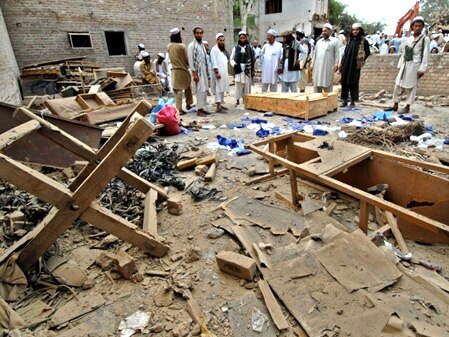
The blast shattered the mosque's front wall and damaged its dome.

Twisted fans hung from the ceiling inside the mosque and prayer mats were scattered across the bloodstained floor.
Police cordoned off the area as people sifted debris looking for survivors.
Shias account for about 20 per cent of Pakistan's 160 million, predominantly Sunni population.

The groups usually co-exist peacefully but outbreaks of sectarian violence involving fighters from both sides have claimed more than 4000 lives across Pakistan since the late 1980s.

10:54 AM

(0) Comments

Relations With U.S. In Crisis After Clash Across Afghan Border

lafrance

,

Pakistani troops in the border regions
(AFP)
Relations between U.S. and Pakistani military forces are in crisis after clashes and a U.S. air strike that hit a Pakistani border post and killed 11 Pakistani soldiers.

Islamabad has called the strike "unprovoked," but the Pentagon says Pakistani troops attacked U.S. forces in Afghanistan.

Pakistan's army says the U.S. air strike early on June 11 on a border post in the Mohmand tribal region "struck at the very basis of cooperation" between the two countries in the war against terrorism.

Describing the attack by an unmanned Predator aircraft as "cowardly and unprovoked," Pakistani Prime Minister Yousuf Raza Gilani told the parliament in Islamabad that a formal complaint is being sent to Washington.

"We will take a stand for sovereignty. We will take a stand for dignity. We will take a stand for self-respect. And we will not allow our soil [to be attacked]. We totally condemn it and will take up the matter through the Foreign Office," Gilani said.

Taliban Fight

But in Washington, U.S. Defense Department spokesman Geoff Morrell defended the U.S. air strike as "legitimate" -- saying the Pakistani troops at the outpost were "hostile" and had attacked U.S. forces across the border in Afghanistan.

"Every indication we have at this point is that the actions that were taken by U.S. forces were legitimate in that they were in self-defense after U.S. forces operating on the border of Pakistan -- in Afghanistan territory -- came under attack from hostile forces. And in self-defense they called in an air strike which took out those forces that were attacking them," Morrell said.

U.S. military commanders in Afghanistan have told RFE/RL and other international media in the past that they do not trust Pakistani security forces on the other side of the border.

Pakistan is supposed to be a key ally in the U.S.-led fight against the Taliban. But U.S. commanders in southern Afghanistan have told RFE/RL that sharing intelligence with Pakistan ahead of a U.S. military operation near the border put the lives of U.S. troops at risk. The U.S. commanders say they fear elements within Pakistan's security forces share U.S. military intelligence with the Taliban -- giving them advanced warning about a U.S.-led attack or even providing information about U.S. positions that help the Taliban carry out their own attacks.

But until recently, it was unusual to hear the Pentagon make such allegations about Pakistani forces.

Low Point

Pakistani journalist Ahmed Rashid, a noted author on the Taliban militants, says relations between the United States and Pakistani security forces appear to be at a low point since the September 11, 2001, terrorist attacks against the United States.

Writing as a guest columnist for the BBC this week, Rashid noted a crescendo of international criticism against Pakistan recently because of peace deals made with the Taliban in the tribal regions -- deals that critics say are allowing Taliban fighters to freely cross the border to attack U.S. and NATO forces in Afghanistan.

Criticism of the peace deals has been made by U.S. officials and lawmakers, NATO commanders, European leaders, UN administrators, and the Afghan government.

June 9 marked the release of a new Pentagon-funded study by the RAND Corporation on the counterinsurgency operations in Afghanistan. That study alleges that individuals from Pakistan's Inter-Services Intelligence (ISI) Directorate and Frontier Corps provide direct assistance to the Taliban and other terrorist groups in the tribal regions.

The author of the study, Seth Jones, says the Taliban and other militants still find refuge in the tribal regions, the Northwest Frontier Province, and Baluchistan because Pakistan's security forces have failed to root them out. Jones concludes that if Taliban sanctuaries in Pakistan are not eliminated, the United States and its NATO allies will face crippling long-term consequences in their effort to stabilize and rebuild Afghanistan.

Pentagon Report

Michael Shaik, an expert on Afghanistan for the International Crisis Group, tells RFE/RL that the report is particularly significant because it is funded by the Pentagon.

"A lot of different organizations, including ours, have been talking about this for the past several years. There has been clear evidence that the Taliban leadership has used Pakistani soil to carry out the insurgency in Afghanistan. So really, the findings of this are nothing new," Shaik says. "What is new is that it is a [U.S.] Defense Department-funded report. RAND has finally come to this realization that individuals in the Pakistani ISI and in the Frontier Corps have been aiding and abetting the Taliban. Individuals. The U.S. administration and also the Pakistani military [have failed] to take these allegations seriously."

But Shaik and other experts on security in the region also note that the RAND study does not go as far as supporting allegations made by government officials in Kabul and New Delhi -- namely, that those individuals in Pakistan's security forces and the ISI support cross-border militancy as part of a covert government plan to achieve Islamabad's foreign-policy goals in the region.

Christopher Langton, head of the defense analysis department at the London-based International Institute for Strategic Studies, tells RFE/RL that the RAND report does reflect growing frustration in Washington about Islamabad's failure to root out Taliban and Al-Qaeda fighters.

"People in the United States are beginning to realize the limitations on Pakistan in dealing with this incredibly difficult problem. And, of course, the Taliban were created by Pakistan with western concurrence at the time. Therefore, it's very, very difficult for Pakistan to wind that clock back," Langton says.

Langton says critics of Pakistan shouldn't ignore the complex domestic political situation that Islamabad faces over the deployment of its troops near the Afghan border.

"There are significant efforts [by Islamabad]. Pakistan has lost nearly 900 troops fighting in the Federal Administered Tribal Areas. Pakistan is suffering a huge number of suicide attacks across the country. And I don't think people should forget this. That's not to say more cannot be done. It probably can. But the domestic difficulties for Pakistan are actually huge," Langton says.

Analysts do agree, however, that fighting between Pakistani and U.S. troops on the Afghan border has raised the crisis in bilateral relations to a new level.

10:46 AM

(0) Comments

Pakistan lawyers on 'long march'

lafrance

Lawyers have been agitating for the reinstatementAbout 1,000 Pakistani lawyers and political activists are undertaking a cross-country rally to demand the restoration of judges sacked by Pervez Musharraf, the president.

The protest, due to end in Islamabad, the capital, on the weekend, aims to increase pressure on Musharraf to step down.

Iftikar Muhammad Chaudhry, Pakistan's deposed chief justice, has set off from his home in Islamabad on Tuesday to join the lawyers and activists.

He is flying down to Lahore to meet the protesters.

Lawyers have spearheaded opposition to Musharraf since the former army chief tried to dismiss Chaudhry last year.

Chaudhry and dozens of other judges were dismissed after Musharraf declared emergency rule in November.

Tough test


"We are out to save the judiciary. We are out to save the country," Mehmood-ul-Hassan, president of the Karachi Bar Association, told the rally as lawyers chanted "Go Musharraf" in a street in the centre of Karachi.

Kamal Hyder, Al Jazeera's correspondent in Islamabad, said: "It is going to be a real test for the government and the judiciary.

"Because this is a make-it or break-it' for the judiciary.

"This is a very big march they have organised and they have had to organise it because ... there are serious divisions within the ruling coalition as to the fate of the president at the moment."

Dubbed a "long march" even though the lawyers will travel in a motor convoy from Karachi to Multan, where the march to Islamabad will officially begin, it is the first major protest the new government will have to contend with.

Both sides have vowed to keep the peace, with the Pakistan government saying that the lawyers have the right to protest.

The protest could also trigger even deeper splits in the coalition led by the party of Benazir Bhutto, the assassinated former prime minister, which is seen as dragging its feet on the restoration of Chaudhry and other sacked judges.

12:08 PM

(0) Comments

Doubts cloud Pakistan Taliban truce

lafrance

,

Pakistan MapPakistan has rejected reports that the government has broken a peace deal with the Pakistani Taliban in the volatile Swat valley.

However, Rehman Malik, the interior minster, implied on Monday that talks with the Taliban are being watched very closely and that the government is losing patience with them due to continued attacks in the region.

Kamal Hyder, Al Jazeera's correspondent in Islamabad, had earlier quoted Malik as saying that escalating violence against government forces meant there was no point in continuing with the deal signed last month.

"The interior minister, in spite of the fact that he has refuted those reports, has admitted that there has been an escalation," Hyder said, "and that if the government did lose its patience and the militants in that area did not stop their activities then the deal would be off."

Hyder said that the government was talking from a position of strength having fortified positions and moved the military into the Swat valley.

"The government's contention is that as long as those people do not allow the government to re-establish its power over the entire region, then they will not give in to any of their [the Taliban's] demands.

'Warning shot'

"Many analysts are looking at this as a warning shot by the government to the Taliban, saying to them that the challenge to the government is unacceptable," Hyder said.

Hyder said that there are elements within the Taliban who are averse to peace with the government and are attempting to sabotage any dialogue between the two sides.

Pakistan's government had promised to pull out troops from the northwestern valley of Swat after signing the peace agreement.

In return the Taliban was expected to shut training camps, hand over foreign fighters and halt suicide attacks on government installations and security forces under the 15-point pact.

Located about 90km from the Afghan border, Swat, which is tribal, though not a part of the Federally Administered Tribal Areas (Fata), had been the main tourist destination in North Western Frontier Province (NWFP) until last year.

Pro-Taliban fighters then launched a violent campaign to enforce Taliban-style law in the region.

2:06 PM

(0) Comments

Musharraf rejects calls to resign

lafrance

Sharif is demanding Musharraf's impeachment[The Pakistan president has rejected calls for him to resign while suggesting he might quit if parliament reduces him to a powerless figurehead.
Pervez Musharraf said on Saturday that he would not quit under pressure.


However, he indicated that he would go if the new government succeeds in reducing his still considerable powers to the point where he feels like a "useless vegetable".


"Parliament is supreme. Whatever the parliament decides I will accept it," Musharraf said on Pakistani news channels, which broadcast his remarks.
"If I see that I don't have any role to play, then it is better to play golf."
His critics are calling for his impeachment and trial for treason - a charge which carries the death penalty.
He has been under mounting pressure since his supporters lost parliamentary elections in February.
Musharraf has said he will not
quit under pressure [AFP]
Media reports this week suggested he was ready to resign and go into exile.
Pakistan's two-month-old governing coalition is divided over how to deal with Musharraf.
Nawaz Sharif is a former prime minister whose government was ousted in Musharraf's 1999 coup.
He currently leads the second-largest party in the coalition.
Sharif is demanding Musharraf's impeachment and trial on treason charges.
He is also pressing hard for the restoration of judges whom Musharraf ousted last year to halt legal challenges to his continued rule.
Asif Ali Zardari, the widower of Benazir Bhutto, the former prime minister, and leader of the Pakistan People's Party, recently described Musharraf as a "relic of the past" who should resign.
But Zardari wants to restore the judges as part of several constitutional amendments that would also remove Musharraf's power to dissolve parliament and appoint military chiefs.

11:12 AM

(0) Comments

Pakistan police foil bomb plot

lafrance

,

At least six people died in a bombing outside the Danish embassy in Islamabad on Monday [Pakistani authorities say they have prevented a bomb attack after three vehicles packed with explosives were discovered in the garrison city of Rawalpindi, the home of the country's army.

Rawalpindi and the capital Islamabad were placed on high alert on Friday after the nearly 500kg of explosives were found.

Officials also reported that six people were arrested late on Thursday, including three people suspected of planning to carry out suicide bombings.

"We have recovered three vehicles with a large quantity of explosives from the Dhok Kala Khan area," Rao Iqbal, a senior police official, said.

"We have made some arrests," he added, but did not give any details.

Two security officials, who spoke to the Associated Press news agency on condition of anonymity, said the arrested men were suspected of wanting to target "sensitive installations" and were being questioned by civil and military authorities in Rawalpindi.

The police operation came just days after a car bomb outside the Danish embassy in Islamabad killed at least six people.

On Thursday, a statement posted on a website purportedly used by armed Islamist groups claimed that al-Qaeda had carried out the attack in response to the reprinting of cartoons deemed to be insulting the Prophet Muhammed.

10:47 AM

(0) Comments

een Describes Madrasah Effort To Make Him A Suicide Bomber

Shakirullah was interviewed at a detention center run by the Afghan intelligence service
(RFE/RL)
KABUL/PRAGUE -- Ever since he was caught three months ago in Afghanistan's Khost Province trying to carry out a suicide attack, 14-year-old Shakirullah has been pondering how he went from childhood in Pakistan to imprisonment in Kabul as an international terrorist.

Just one year ago, Shakirullah was living with his family in his native tribal region of South Waziristan, in Pakistan. The world Shakirullah knew in his village of Jandul revolved around his father, Noor Ali Khan, his mother, and three older brothers.

But Shakirullah's childhood in the rugged mountain region near the Afghan border came to a dramatic end last fall when his family sent him to a religious boarding school -- the nearby Salib madrasah in South Waziristan -- to receive instruction from conservative Islamist clerics.

The boy says teachers had taught him the Koran for half a year, then gave him an explosives-packed suicide vest and took him across the border into Afghanistan.

Shakirullah was picked up before he could blow himself up near U.S. troops, a mission that minders at his Pakistani madrasah assured him would bring him eternal life.

He is now being held at a facility run by Afghanistan's national intelligence service -- a detention center that keeps the teenager separated from older Taliban fighters, hardened criminals, and convicted murderers.

'Never Die'

When Afghan officials allowed RFE/RL's Radio Free Afghanistan into the facility to interview Shakirullah, the boy describes a militant network in Pakistan that "forced" him to become a suicide bomber. The teen also directly implicates clerics at the madrasah as being part of that network.

"[I was attending] Salib madrasah. About 50 other people were attending," Shakirullah said. "The teachers were all from Pakistan. I was there for five or six months."

Shakirullah says that his instruction focused entirely on the Koran while he was at the madrasah. But he says the clerics started urging him to become a suicide bomber after he finished studying the Koran.

Shakirullah also says several of the teachers at the madrasah told him that he would "never die" if he sacrificed himself as a suicide bomber in neighboring Afghanistan.

According to Shakirullah, his teachers increased their pressure on him to commit a suicide-bomb attack after he asked to see his mother and father. He says his teachers told him he was not allowed to see his parents before the attack, but assured him that he would "come back" to see them afterward.

Shakirullah identifies a teacher at the madrasah named Azizullah as the person who transported him across the border into Afghanistan's Khost Province, urging him to blow himself up. He says Azizullah also provided him with an explosives-laden vest and instructed him to detonate the device when he got close to a group of U.S. soldiers.

"They told me to go to Afghanistan and carry out a suicide attack and that I would come back," Shakirullah says. "[Azizullah] didn't allow me to inform my family. I was forced to come [to Afghanistan]. When I finished [studying] the Koran, they told me, 'Now you carry out a suicide attack and you will come back to visit your parents.' Then I was brought to Afghanistan."

Close Call

Authorities in Kabul say troops from the Afghan National Army first noticed the teenager as he was walking alone toward a security checkpoint in Khost Province.

Observing that the boy was acting confused and was wearing a suspiciously oversized vest, the Afghan soldiers stopped Shakirullah from detonating the explosives. Instead, they took him into custody for questioning.

Shakirullah says his Afghan jailers have treated him well and that he has not been abused or tortured during the many interrogation sessions he has undergone.

He says that in the three months since his arrest, he has had plenty of time to think about how his teachers at the madrasah took advantage of his impressionable age.

Shakirullah now says the madrasah teachers lied to him -- giving him "bad advice and trying to kill me along with other Muslims."

As for the future, Shakirullah says he is happy just to be alive and safe. But he says he wants to continue his studies to better understand how he was led astray by the madrasah teachers. The boy also says that he misses his mother and wants desperately to see her again.

reported by RFE/RL's Radio Free Afghanistan correspondent Rezwan Murad in Kabul and Jan Alekozai in Prague; written by Ron Synovitz in Prague


12:24 PM

(0) Comments

At Least Six Killed In Car Bombing Outside Danish Embassy

lafrance

A suicide bomber killed at least five people outside the Danish Embassy in Islamabad
(AFP)
A suicide attacker detonated a car bomb in front of the Danish Embassy in Islamabad, killing at least six people and injuring more than a dozen.

Authorities say about 30 kilograms of explosives were packed into the car. The blast heavily damaged the embassy and destroyed its gate and nearby vehicles in the upscale residential district of the Pakistani capital. A huge crater was gouged into the road outside.

All of the dead are reportedly Pakistani, including two police officers.

Pakistani Foreign Secretary Salman Bashir visited the scene of the bombing and called it a "very devastating attack."

In Copenhagen, Danish Foreign Minister Per Stig Moeller called the bombing cowardly and "totally unacceptable."

Rehman Malik, the Interior Ministry's adviser to the Pakistani prime minister, told journalists that investigators are still trying to confirm exactly who carried out the attack. No one has claimed responsibility.

Malik says security officials believe the suicide attacker was targeting the Danish Embassy in reaction to an editorial cartoon that was republished by a Danish newspaper in February. He said the embassy had been receiving threats for a long time.

"This is a very sad incident, and it's a tragedy for the whole nation," Malik said.

Originally published by Danish newspapers in 2005, the controversial cartoon infuriated Muslims around the world by depicting the Prophet Muhammad wearing a turban with a bomb in it. Since Muslims consider any depiction of the Prophet Muhammad as blasphemous, a cartoon depicting him as a terrorist hit a particularly sensitive nerve in the Muslim world -- leading to violent protests in 2006 that included attacks on Danish diplomatic missions around the world.

The newspaper cartoons also have led to calls within Afghanistan for Denmark to withdraw its 700 soldiers from the NATO-led International Security Assistance Force.

The blast also raises concerns about a peace accord that was signed last month between pro-Taliban militants and the local government in the Northwest Frontier Province. Security analysts had warned that the truce would give militants space to plan and carry out new attacks in other parts of Pakistan, as well as in neighboring Afghanistan.

Pakistani officials said they are doing everything they can to protect all foreign diplomats and embassies.

RFE/RL's Radio Free Afghanistan contributed to this report, which also incorporates agency material


10:24 AM

(0) Comments

Reports Hint At Possible Prisoner Swap With Militants

lafrance

Ambassador Azizuddin after his release on May 17
(AFP)
The Pakistani government has denied local reports claiming that the release of Islamabad's kidnapped ambassador to Afghanistan was part of an exchange for Taliban prisoners. A number of Pakistan observers, however, tell RFE/RL they suspect that some kind of prisoner swap did occur.

Local media suggest that scores of militants were released and hundreds of thousands of dollars in ransom was paid to secure the release of Ambassador Tariq Azizuddin and dozens of captured government troops.

The development further fuels a policy debate over the negotiating with Taliban and other extremists, particularly as U.S. officials have warned Islamabad about making deals with fighters in Pakistan.

Azizuddin was kept captive by Taliban fighters for more than three months before he was released to government officials on May 16. The 56-year-old ambassador was abducted in February by a criminal group in Pakistan's tribal region as his limousine approached the border crossing into Afghanistan near the infamous Khyber Pass. The abductors then reportedly passed Azizuddin on to Taliban fighters in South Waziristan who held him until his release.

The day after he was freed, Azizuddin said a Pakistani security operation led to his release. Azizuddin said details about that operation would be revealed in the future.

He credited his release to "the efforts of the government of Pakistan, on the orders of the prime minister, on the order of the adviser for the interior, and on the chain of actions set about on the orders of the adviser for the interior and the Ministry of Interior."

The prime minister's adviser on interior affairs, Rahman Malik, is currently the senior ranking civilian official in charge of security in Pakistan. He claims that "there was no deal involved."

"There was no exchange for terrorists and there was no exchange of any individuals [for the release of Azizuddin]," Malik says.

Despite the government denials, a growing number of reports in Pakistan refute the official version of the story. Media reports have alleged that Islamabad freed up to 55 Taliban militants and also paid out some $287,000 in exchange for the release of Azizuddin and dozens of captured government troops.

Rustan Shah Mohmand, a former Pakistani ambassador to Afghanistan known for his hard-line pro-Taliban stances, tells RFE/RL's Radio Free Afghanistan that he has no doubt that Azizuddin's release was the result of weeks of negotiations between Islamabad and militants.

"I think that [insurgents] were definitely released [by Pakistan's government] and that the release of the ambassador was secured through negotiations," Mohmand says. He insists that "in those talks it was decided that the Pakistani Taliban would release the ambassador in exchange for the release of Taliban prisoners."

Ijaz Khan, a professor of international relations at Peshawar University, tells RFE/RL's Radio Free Afghanistan that "the new reports we have been getting are now similar in almost all newspaper and media outlets."

Khan describes those reports as claiming that the former Afghan Taliban regime's onetime defense minister, Mullah Obaidullah Akhund, and "other high-profile Taliban" were freed by the government. In exchange, he says, reports point to Taliban fighters' release of the Pakistani ambassador and "about 50 Pakistani soldiers and other abductees."

"The Taliban have confirmed this [prisoner exchange] in their statements, but the government has kept silent about it," Khan says. "I think that this release could not have happened without some kind of deal, so these reports about a prisoner exchange appear to be correct."

More recent media reports refute the claim that Islamabad has freed Mullah Obaidullah, saying militants demanded his release but that he had already been handed over to U.S.-led coalition forces in Afghanistan.

Neither the U.S. military nor Pakistan's government would comment to RFE/RL about Mullah Obaidullah's current whereabouts.

Media reports in Pakistan identify freed militants as including Mufti Yousuf -- a top Taliban commander in eastern Afghanistan who had been arrested in Peshawar by Pakistani intelligence officials.

Abdul Rahim Muslim Dost, a former Guantanamo Bay detainee who had been transferred to Pakistan's Inter-Services Intelligence, was also reportedly handed over to militants in Razmak, North Waziristan, on May 17.

The reports say Baitullah Mehsud, a pro-Al-Qaeda Pakistani Taliban leader, was an astute negotiator and insisted that Taliban-held captives would be released only in exchange for prisoners of similar value.

Speculation is likely to continue in the absence of compelling evidence one way or the other.

What is clear about the current situation is that the Pakistani government, sworn in at the end of March, has begun a policy of engagement with the Taliban by negotiating through tribal leaders to persuade Mehsud to end militant operations in Pakistan's tribal areas.

U.S. General Dan McNeill, commander of NATO's 47,000-strong International Security Assistance Force (ISAF) in Afghanistan, says such negotiations have raised concerns within the alliance.

McNeill confirms that NATO has reinforced its troops along the border in case the peace deal enables the Taliban to launch more cross-border attacks into Afghanistan.

McNeill says NATO's analysis of previous peace deals between the Taliban and Islamabad shows that whenever dialogue is being conducted with the Taliban -- or when talks lead to peace deals in Pakistan -- there is a spike in militant attacks on the Afghan side of the border.

U.S. Deputy Secretary of State John Negroponte told a Congressional committee in Washington on May 20 that the United States is "concerned about the possibility of negotiations between the government or elements of the government and these extremist groups."

contributors to this report include RFE/RL's Radio Free Afghanistan correspondents Abubakar Siddique in Prague and Najib Aamir in Peshawar